
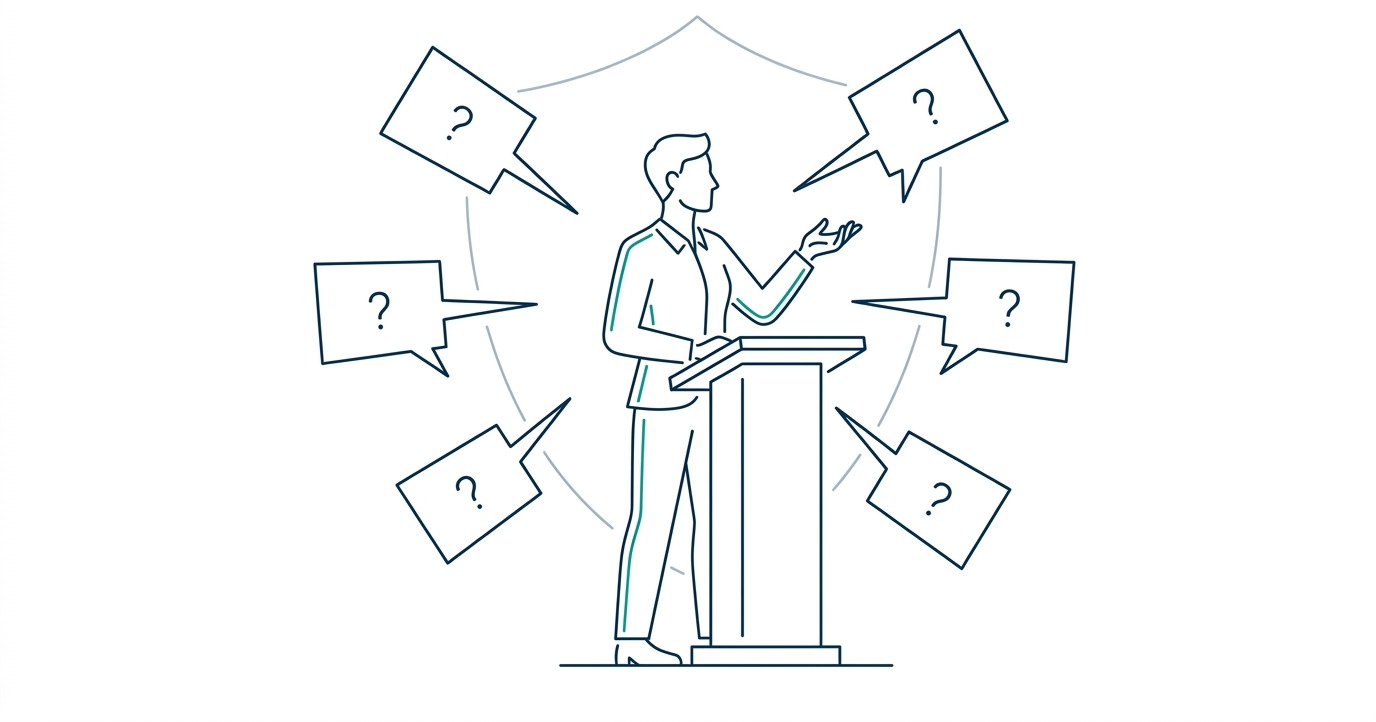
“Seven Deadly Questions” Teamwork Session
This workshop helps leaders and teams stay calm, clear, and credible when hit with hostile, high-stakes, or left-field questions — in meetings, town halls, and board or client settings. Participants leave with practical mental models, ready-to-use response structures, and rehearsed language they can adapt under pressure.
The Seven Deadly Questions
- “Which is more important to you, A or B?” — false choice
- “Can you guarantee X?” — forced absolute
- “You said X, so then…” — words in mouth
- “What if you were X?” — hypothetical
- “What aren’t you telling us?” — blanket transparency
- “Why should we believe you?” — licence to trust
- “Who is responsible for this?” — assigned blame
Agenda (2–2.5 hours)
- Open and framing (15 min): Quick poll on when tough questions go wrong. Core principles — separate the question from the attack, buy time, bridge to your message, and close with a clear next step.
- Tools for tough questions (30 min): One or two simple frameworks, including Pause–Clarify–Acknowledge–Answer–Advance and a structure for “I don’t know yet.” Micro-skills: body language, voice, and managing your nervous system under pressure.
- The 7 deadly questions lab (30 min): Small groups rotate through stations, each with a deadly question relevant to their context. Live practice using the frameworks; peers score on clarity, calm, and honesty.
- Tough conversations (60 min): Handling difficult one-to-ones — performance issues, pushback, and emotion. Role-play real scenarios brought by participants: manager–employee, leader–stakeholder, client–consultant.
- Personal playbook and commitments (15 min): Each person drafts a “hot-seat script” — likely tough questions in their role, best-fit responses, and a pre-meeting prep checklist. One practice commitment for the next 30 days.
The session suits senior leaders, people managers, spokespeople, and client-facing experts who regularly field challenging questions. A virtual follow-up (60 min) 4–6 weeks later can revisit real situations, refine playbooks, and reinforce habits under real-world pressure.